Summer has a way of making you feel behind before it has even had the decency to get fully started.
One minute, you are thinking about all the photos you want to take, the little stories you want to save, and maybe even the summer scrapbook you might finally keep up with this year. The next minute, your camera roll is full of end-of-school photos, pool pictures, camp screenshots, backyard dinners, beach towels, and seventeen almost-identical photos of someone in the water that you cannot delete because each one feels slightly different.
And suddenly your brain starts whispering, “Well, maybe I already missed the beginning.”
You didn’t.
You’re not too late to start a summer scrapbook. You just need a way to stop thinking of summer as one big chronological project and start seeing it as a collection of small stories you can gather as you go.
You can start your summer scrapbook in the middle
The beginning of July is not too late. It might actually be the perfect time for a summer scrapbook reset, because now you have enough evidence to see what this summer is starting to become.
At the beginning of June, summer is still mostly an idea. It is full of expectations, loose plans, hopeful lists, and maybe a few things you think you want to document. By the middle of June, the real patterns are starting to show themselves. You can see where your people keep landing. You can see what keeps repeating. You can see whether this is going to be a pool summer, a porch summer, a baseball summer, a beach bag summer, a “great indoors because the heat is personally attacking us” summer, or some beautifully chaotic combination of all of it.
That’s not being behind. That is finally having a vibe to work with.
The trick is to stop thinking of summer scrapbooking as a big chronological assignment. You don’t need to go back and reconstruct every single day since school let out. That, my friend, is where projects go to die, usually under a pile of guilt and 900 unsorted photos.
What you need instead is a reset. A small, simple system that helps you gather what already happened, notice what is still happening, and give the rest of summer somewhere to land.
Start with the photos you already have
Begin by looking back at the last couple of weeks, but do it lightly. This is not a courtroom investigation. You are not building a case file.
Open your camera roll and pull anything that feels like summer. The last day of school. The first ice cream. Pool photos. Beach towels. Backyard dinners. Rainy afternoons. Baseball games. Library books. A messy kitchen counter. The cooler by the door. The sandals no one ever puts away. The photo that is technically terrible but somehow tells the whole truth.
Don’t worry yet about whether the photos are “good enough.” That is not the first question. The first question is whether they feel like proof.
Proof that summer was here. Proof that your people were in motion. Proof that the ordinary stuff was happening while you were busy living it.
Choose a few summer story words
Once you have a little pile of photos, choose a few summer words to hold them. Not a giant album plan. Not a complicated theme. Just a handful of categories that make the season easier to see.
Words like pool life, sunshine, backyard, ice cream, BBQ, summer reading, great indoors, bedtime-ish.
These words work because they are loose enough to catch a lot of different memories. “Pool life” can hold the beautiful water photos, but it can also hold the goggles on the kitchen table and the towel mountain by the back door. “Bedtime-ish” can hold the late sunsets, the pajama porch moments, the kids who are absolutely not tired, and the whole seasonal fantasy that anyone is going to sleep on time.
This is where the pressure starts to soften. You are no longer trying to tell the entire story of summer in perfect order. You are just making little homes for the pieces that keep showing up.
That shift matters because most summer memories are not big events. Yes, there might be fireworks and vacations and beach days and cookouts, and those are definitely highlights. But the real texture of summer usually lives in the repeats. The same chair on the deck. The same popsicles in the freezer. The same flip-flops by the door. The same “just five more minutes” at the pool. The same dinner outside because nobody wants to turn on the oven. The same late-night laundry because every towel in the house is somehow damp.
Those are the things we think we will remember because they are everywhere while we are living them. Then September comes along with backpacks and permission slips and real shoes, and suddenly the whole season starts to blur.
That is why giving those ordinary moments a name now can be so helpful. A word becomes a little hook. It helps you notice the story while it is still happening.
Create a simple weekly photo rhythm
Next, create a rhythm for the next few weeks that is so simple you almost can’t mess it up.
Think about that Friday night when everyone is flipping through the Netflix queue and you are already scrolling through your phone anyway. Instead of losing twenty minutes to Instagram, open your camera roll and move a few favorite summer photos into one album on your phone.
Call it Summer 2026, Summer Stories, Summer Scrapbook, or whatever your brain will actually recognize later. Add the imperfect pictures. Add the funny ones. Add the ones that would never make it into a frame but absolutely belong in the story.
This is not about organizing your entire photo life. Please do not invite that level of chaos into your weekend. This is just about giving your summer photos one simple place to gather.
Save the little story details before they disappear
When a little detail comes with the photo, give that detail somewhere better to live than your already-overworked brain. This is where my Joy Journal method can be so helpful.
Your camera roll can hold the picture, but it cannot reliably hold the little piece of story that makes the picture matter later. For that, send yourself a quick email with a simple subject line like “first real pool day,” “rainy afternoon inside,” or “the week the boys lived in swim trunks.”
Attach the photo if you want to keep everything together. Then, in the body of the email, add one sentence if you have it. Not a deep reflection unless you are feeling wildly inspired and possibly over-caffeinated. Just one line.
- “First real pool day.”
- “What’s better than bologna sandwiches and potato chips at the beach?”
- “This was the week the boys lived in swim trunks.”
- “Rain all day, movies inside, no regrets.”
- One line is often enough to bring the photo back to life later.
And that’s it. That is the whole reset. Gather what already happened. Choose a few summer words. Create a light weekly rhythm so the next few weeks have somewhere to go.
No giant catch-up project. No dramatic declaration that you are finally going to get your entire photo life together. We are not doing that to ourselves. Instead, we are making a small system that can survive actual summer and still be fun.
A simple Canva template option if you want a head start
This is the place my Summer Defined scrapbooking templates grew from.
I wanted a summer scrapbooking project that did not start with a blank page and a little bit of overwhelm. I wanted something that gave the season a little structure without making it feel boxed in. Something you could open in Canva, play with a little, print if you wanted to, and actually use without turning summer into another thing you were supposed to be keeping up with.
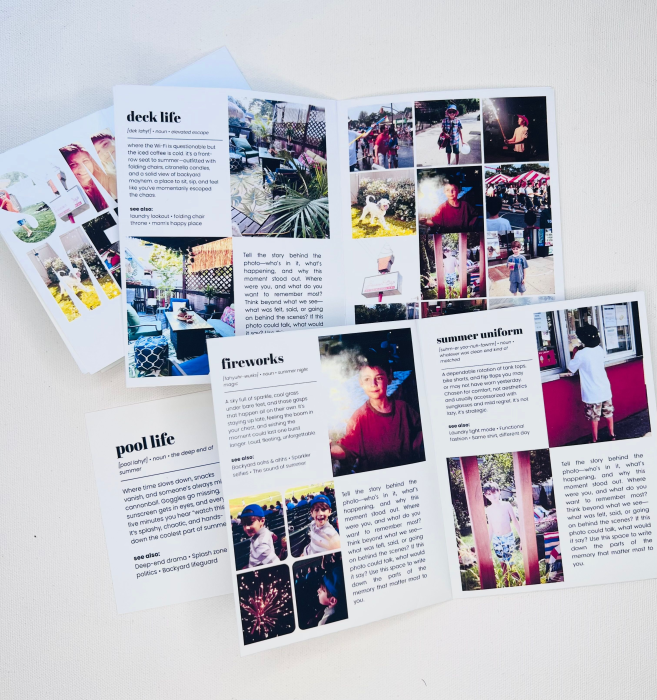
If you want a simple place to start, [Summer Defined] is the set of printer-friendly 6×8 Canva scrapbook templates and definition-style story prompting cards I made for exactly this kind of summer reset. Instead of staring at your photos and wondering where to begin, you can start with a word.
Pool life. Sunshine. Backyard. Great indoors. BBQ. Ice cream. Bedtime-ish.
The definitions are more than they seem. They are prompts. Little invitations to notice what is already happening.
You can use them to go back through the last couple of weeks and pull the pieces you already have. You can use them to stay lightly caught up as summer keeps unfolding. You can even print the cards ahead of time and let them sit where summer is actually happening: on the kitchen counter, tucked into a planner, clipped to a bulletin board, or waiting in a little basket with a pen nearby.
When a moment fits, jot a few words on the back. Nothing fancy.
By the end of the season, those cards become more than page starters. They become little memory keepers in their own right, holding the thoughts your camera roll can’t.
The point is not to document summer perfectly. The point is to make it easier to begin, easier to continue, and easier to remember what this season actually felt like.
So if you are already feeling behind on summer, take a breath.
You are not behind. You are standing in the middle, which means you finally have enough of the season in your hands to see its shape. You do not need to start over. You do not need to catch every moment. You do not need to turn summer into homework.
You just need to choose a few words, gather a few pieces of proof, and give the rest of summer somewhere soft to land.
CANVA (All Products)
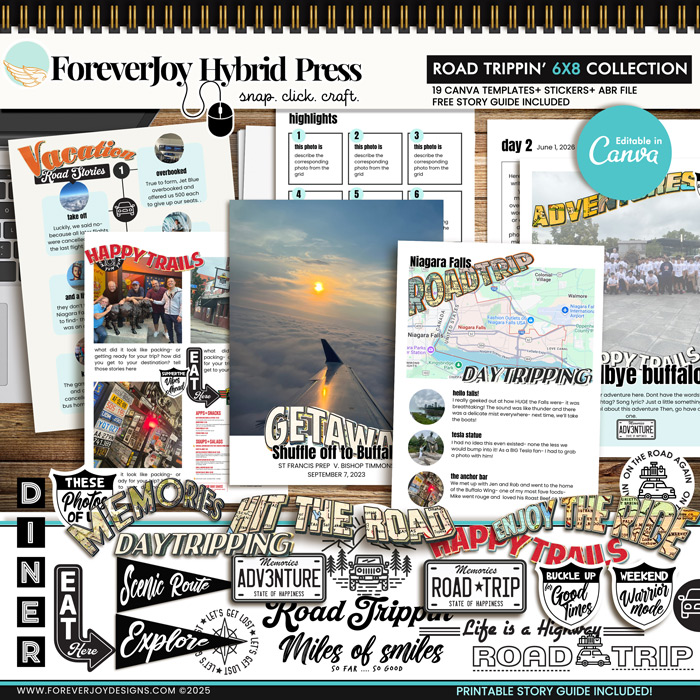
No Photoshop? No problem. These drag-and-drop Canva scrapbook templates make creating easy anywhere – your craft room is as close as your Wi-Fi! SNAP your photos, CLICK your mouse and CRAFT your stories your way in no time!