Here’s how to stop documenting the season like it’s a homework assignment.
Don’t believe the hype: nobody documents every day of summer. Or at least, almost nobody with a real kitchen, a full camera roll, wet towels on the floor, and people asking what’s for dinner while standing directly in front of the refrigerator.
And if someone out there is documenting every single day in perfect chronological order, good for them. Truly. May their pens never dry out and their photo storage be eternally generous. But for the rest of us, summer doesn’t usually arrive in neat little daily chapters. It arrives all at once, loudly, with a mess on the counter, shoes by the door, a pool bag nobody fully unpacks and dinner you forgot to defrost. #pizzafordinneragain
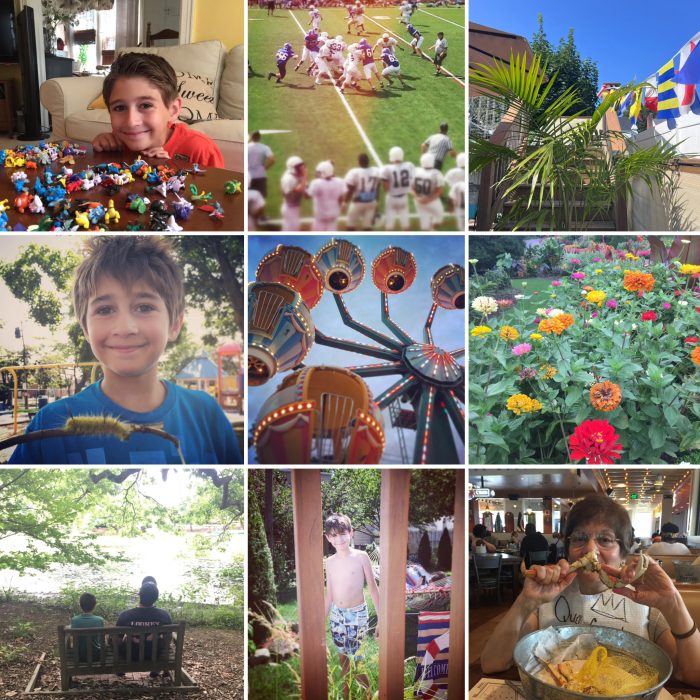
Somewhere around the third week of June, it happens. You’ve got photos on your phone from the pool and the cookout and the random night where everyone stayed outside until way too late because the conversation around cornhole was flowing.
Good photos. Real ones. The kind you actually want to remember. And yet somehow, nothing has been documented. Not because you missed something but probable because you’re thinking about summer memory keeping in a way that makes it so much harder than it needs to be.
Most of us were handed the same mental model for documenting our lives: you start at the beginning, you move forward in time, and you record what happened. Day by day, event by event, clean and chronological. That works fine if you’re a ship captain keeping a log. It works less well when you’re trying to document a season that’s both fast paced and unscheduled all at the same time. The second you skip a week, the whole thing starts to feel broken. Now you’d have to catch up, and catching up sounds exhausting, so you don’t start at all. No bueno.
That’s how the calendar turns your summer scrapbook into a test you’re already failing, which is a terrible way to treat a season that is supposed to feel loose around the edges. Summer is sandy towels, late dinners, last-minute plans, the ice cream truck’s endless song, fireflies, bonfires, ballgames and days filled with glorious boredom. Trying to force all of that into a perfect timeline is a very efficient way to suck the joy right out of it.
So here’s the better way in: stop trying to document summer by date and start documenting it by theme. Not events, exactly, but categories and patterns. The repeated little pieces that make your summer different from anyone else’s. Because the real story of summer usually isn’t hiding in the calendar. It’s hiding in what kept showing up.
- Start with what you ate. Not a food diary, because no one needs a formal record of every turkey sandwich unless turkey sandwiches were somehow having a big emotional arc this summer. I mean the food that defined this particular season: the frozen lemonade from the place on the corner, the hot dogs, the farm stand peaches, the watermelon you kept buying with big hopeful energy even though half of it always went soft in the back of the fridge. The snacks that lived in the pool bag. The dinner you made on repeat because turning on the oven felt personally offensive. That is a summer story.
- Then look at what the house looked like. Wet towels over chairs, flip-flops by the door, sunscreen on the counter, the porch fan running at ten o’clock at night because nobody wanted to go inside yet. The kitchen after everyone came home from swimming, when the whole room felt like chlorine, crumbs, and mild chaos. These are the details that feel too ordinary to document while you’re living them, which is exactly why they matter later.
- You can also make a page about what everyone was obsessed with, and this is one of those categories you will be so glad you saved. Because you will not remember, three years from now, that your son spent an entire summer rewatching the same four YouTube videos about building foam blasters. But he did. It was this summer. It was delightful and slightly maddening and completely his. The tiny fixations of a season disappear fast: the same show, the same snack, the same pool float, the same song, the same phrase someone kept repeating until the whole family wanted to launch it directly into the sun. That stuff is not filler. That is time-stamped family history in disguise.
- Think about what summer sounded like, too. Cicadas. The ice cream truck. The neighbor’s lawn mower every Saturday morning at seven, because apparently peace was never an option. The slap of screen doors, the fan in the window, the low-level roar of a house at the end of a hot day when everyone is tired and nobody will admit it. You may not have a perfect photo for that, and that’s fine. A scrapbook page does not always need photographic evidence. Sometimes a few lines of journaling are the whole point. Sometimes the story is not “look at this thing.” Sometimes the story is “this is what it felt like to live here right now.”
- And then there is what happened after dinner, which might be where the real summer lives. The walks that started because nobody could agree on a show. The driveway conversations. The last-minute swims. The extra hour outside because the sky still looked awake. The lightning bugs, the porch sitting, the kind of nothing that somehow becomes the thing you remember. Those little in-between moments do not always get treated like events, but they are often the moments that make the season feel like itself.
- You can make a page about what changed, too. Someone got taller. Someone got braver in the water. Someone stopped needing help with something they needed help with last year, or needed you in a new way. The house shifted. A room got painted. A routine changed. Something quietly became different while you were busy making dinner and looking for the good towels. And just as importantly, you can document what stayed the same: the same beach chairs, the same sunscreen argument, the same late-day crankiness, the same favorite spot, the same summer ritual that somehow holds everything together, even if nobody would think to call it a tradition.
This is the trick: when you scrapbook by theme, you stop needing everything. You don’t need the perfect photo from July 10th. You need one photo that tells the story of pool life, or deck life, or road trip snacks, or the great indoors, or whatever summer looked like in your house this year. Maybe it is a photo of the fan in the window. Maybe it is the kids at the table. Maybe it is the beach bag dumped by the door. Maybe it is the half-melted ice cream, the stack of towels, or the suitcase that stayed half-unpacked for three days because unpacking is where vacation joy goes to die.
Or maybe you never got a photo at all and you just write it down, which really is enough. Actually, it more than counts. Sometimes that is the page you’ll care about most later because it saves the part a photo couldn’t quite catch.
That’s the beauty of categories. They’re flexible. They forgive the weeks you didn’t document. They let you find the right story instead of the next one.
And when you sit down with your phone and your templates and your stack of memories, you’re not reconstructing a timeline. You’re finding patterns. That makes your camera roll a lot more manageable.
Instead of opening it and scrolling backward like you’re searching for evidence in a very low-stakes crime drama, you can use it like a search tool. Type in “pool,” “beach,” “ice cream,” “BBQ,” “porch,” “sunset,” “road trip,” “hotel,” “backyard,” or whatever words fit your summer. Suddenly you are not dealing with four thousand photos. You are dealing with a handful of possibilities. Pick one. Tell that story. Move on.
This is exactly the idea behind my Summer Defined Canva template kit. Instead of handing you a blank page and wishing you luck, each layout gives you a way into the story. The definition-style titles like “pool life,” “BBQ,” “bedtime-ish,” “deck life,” and “the great indoors” are not just cute labels. They are prompts. They are ready-made search terms. They give your brain somewhere to start when your camera roll is acting like a junk drawer with thumbnails.
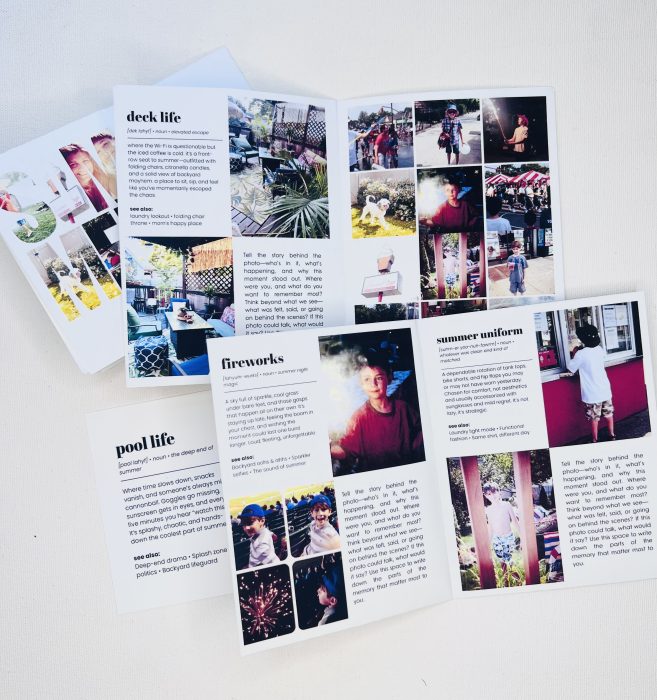
Type “pool” into your photos app and suddenly you’ve got ten candidates instead of four thousand. Drop one into the template, add the detail you don’t want to forget, and move on. That’s the whole point: not perfect documentation- just one story at a time.
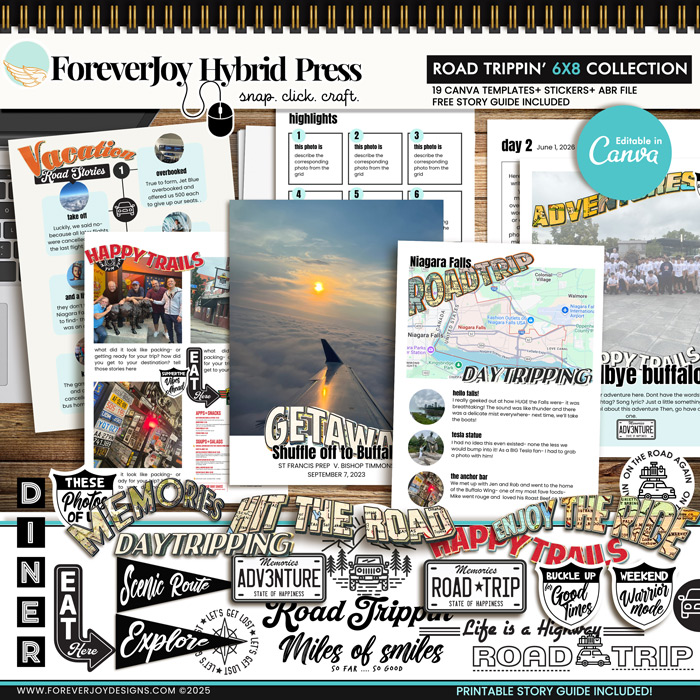
And if your summer has a travel chapter, Road Trippin’ works the same way for the miles, snacks, roadside stops, hotel room chaos, car conversations, and signs your kid reads out loud for three states in a row. It gives you a place for all the in-between pieces that usually get buried under the “big” vacation photos, even though the gas station snack negotiations may have been the most accurate portrait of the trip.
You don’t have to use the templates as a full album, either. Use one page. Use three. Use them when your camera roll feels like it needs its own personal assistant and you do not have the energy to start from scratch. Because nobody is checking your summer scrapbook for attendance. You don’t need a perfect timeline.
Start with what kept showing up. Start with one category. Start with one small story.
That’s enough to begin.
xo- renne
CANVA (All Products)
No Photoshop? No problem. These drag-and-drop Canva scrapbook templates make creating easy anywhere – your craft room is as close as your Wi-Fi! SNAP your photos, CLICK your mouse and CRAFT your stories your way in no time!